Measurements
Every figure below is the median of three repeats, produced by the same side-blind scorer, on the same engine for both sides. The corpora, the questions, every answer and every scoring decision are in the repository — re-run them, and if you find a scoring bug, open an issue: two have been found so far, and both were penalising the competitor.
Retrieval, 0.6
Measured on this repository's own field corpus, engine-free. A known-item query is a line from the store with its most distinctive terms removed, so the words alone cannot find it — the protocol needs no hand-written gold and cannot be tuned to.
Which encoder — 20,000 lines, 180 queries, two terms removed:
| encoder | first hit | MRR | index build |
|---|---|---|---|
| a distillation of our own | 27% | 0.306 | 1.2 s |
paraphrase-multilingual-MiniLM-L12-v2 (torch) |
66% | 0.710 | 36.1 s |
| the bundled static matrix | 84% | 0.883 | 0.3 s |
Which layer — 103 documents, the store's own find:
| first-3 hit | |
|---|---|
| words alone | 92% |
| + meaning at the DOCUMENT layer | 99% |
| + meaning at the LINE layer | no change |
| lines chosen by meaning INSIDE a document | 78% → 31% |
End to end — 115,913 lines, 304 queries, by whether the ANSWERING line reaches the five the engine is shown:
| first | in five | |
|---|---|---|
| words alone | 31% | 32% |
| + meaning channel | 31% | 60% |
| + late-interaction reordering | 34% | 79% |
How much reordering is worth, by how vague the question is — the same corpus, by terms removed from the query:
| terms removed | single vector | late interaction |
|---|---|---|
| 2 | 0.864 | 0.884 |
| 4 | 0.779 | 0.825 |
| 6 | 0.707 | 0.807 |
Cost retractions, 0.6
Three hedges against weak retrieval were re-measured after it improved, and each had stopped earning. Eleven field questions with gold answers:
| hedge | measurement | now |
|---|---|---|
| 3 candidate subsets per question | every admitted answer came from the WIDE block; the narrow ones won nothing | CANDIDATES = 1 — 139 → 104 calls, 4/11 → 5/11 |
| 2 views per judge | the second view confirmed nothing, on either judge | VIEWS = 1 — 8 fewer calls in 104 |
| the offline expansion index | kept zero of a hand-written perfect query set | deleted, −607 lines |
| first question on a 115k-line store | 10.6 s → 0.13 s (the derived index is saved) |
| a deterministic question asked twice in one turn | asked once — one refusal turn, −2 calls, −11k tokens |
Against GraphRAG
| same engine (gpt-4o-mini), 3 samples each | LMM | GraphRAG |
|---|---|---|
| Fictional corpus, 17 q | 17/17 · spread 0 | 16/17 · spread 0 |
| NIST SP 800-63B (45k tokens), 13 q | 11/13 · spread 0 | 7/13 · spread 2 |
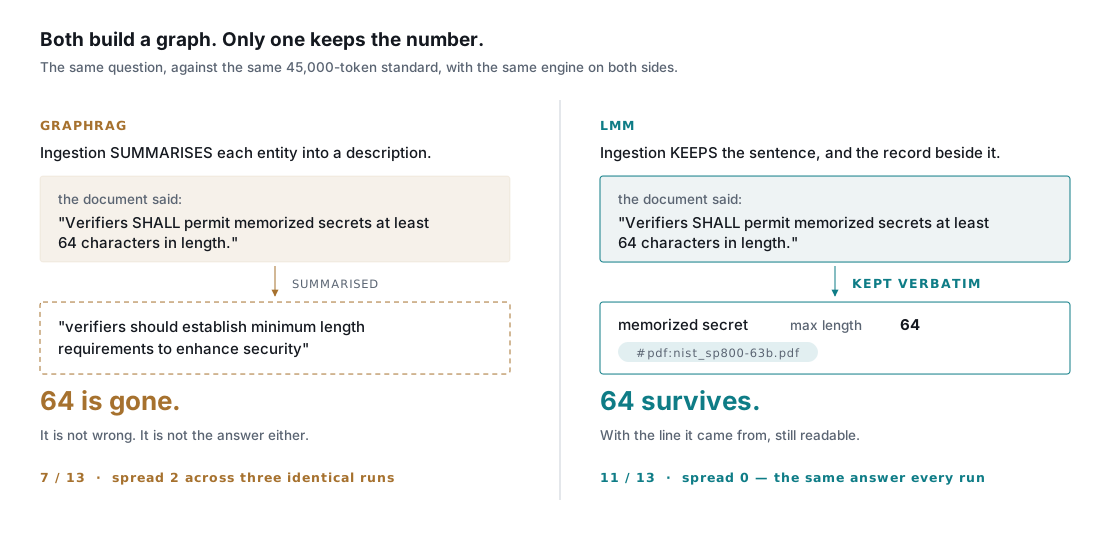
GraphRAG loses specific values. Its indexer summarises entity descriptions, and a summary abstracts the number away — asked for a maximum length the standard states as 64, it answered "verifiers should establish minimum length requirements", a sentence in which the value never appears. LMM's misses are refusals — reworded questions whose answer was in the document and not retrieved. One failure mode approximates; the other declines. They are not the same failure.
Cost
| NIST SP 800-63B | LMM | GraphRAG |
|---|---|---|
| Indexing | 0 model calls | 220 calls · 498,230 prompt tokens |
| Per question | ~5 calls | 2 calls · ~10,100 prompt tokens |
Ingestion is the structural difference: LMM reads the document verbatim and decides nothing at write time, so reading is nearly free and nothing is lost before anyone asks.
Language independence
The same fictional world, line for line, in three languages — same questions, same gold keys, same invented names:
| median of 3 | samples | |
|---|---|---|
| Turkish | 17/17 | 17 · 17 · 17 |
| English | 16/17 | 15 · 16 · 16 |
| Spanish | 15/17 | 15 · 15 · 15 |
What the gate is actually for — a correction from the field
An integration measuring 44 supplier/requirement cells against two real tender documents published a correction to its own earlier report, and it corrects ours too. Its first comparison put the whole document in the prompt — no retrieval at all — and the gate looked like it was buying two fewer fabrications. That was the wrong control.
The right one is the same retrieval LMM uses (evidence.find, zero model
calls) with a single engine call after it instead of the gate. Same engine,
same questions, 44 cells:
| calls | prompt tokens | seconds | false-covered | |
|---|---|---|---|---|
| document in the prompt | 44 | 292,749 | 125 | 5 |
| the same retrieval, one call, no gate | 44 | 28,083 | 88 | 3 |
| LMM | 378 | 313,173 | 491 | 2 |
Read that column in two steps. Giving the model six retrieved lines instead of the whole document removes two invented coverages; adding the gate on top of those same lines removes one more — inside a run-to-run variance the reporter measured at about two cells. So on that corpus the gate's contribution to non-fabrication sits at the noise floor, for a reason worth stating plainly: once retrieval is good, the fabrication the gate exists to stop was mostly not happening. Naive RAG over the same retriever was 11× cheaper in tokens and 5.6× faster.
What the same run shows the gate DOES buy is something neither side had measured. Counting what each approach was willing to say across the 44 cells:
| "partly" | "fully" | "not covered" | |
|---|---|---|---|
| same retrieval, no gate | 31 | 7 | 6 |
| document in the prompt | 14 | 29 | 0 |
| LMM | 0 | 34 | 10 |
Unverified answering hedges: 31 of 44 cells came back "partly covered", and the whole-document variant did not once say "not covered" in 44 tries. LMM commits — 34 to 10, and 8 of those 10 refusals are correct. A matrix where 31 rows of 44 say "partly" tells its reader nothing.
That is the property verification sells, and it is not accuracy: the answers do not drift to the middle. A system that never commits is never wrong and never useful. The shape of the number, for anyone repeating this: over a fixed question set, how often does the system return the non-committal option. It costs nothing to compute and separates verified from unverified answering far more sharply than accuracy does.
The same run also reports zero fabrications in 44 cells — the promise
held exactly as written. Both of LMM's false-covered cells were checked
against the document by hand: one was the abstention-stamp defect, closed
in 0.8.0 (a refusal published with abstained=False), and the other is a
true, sourced sentence answering a different question than the one asked.
Which points at the limit that actually bites, below.
The conversation surface
Every other number on this page is document question-answering. The half
this project's name promises had no current figure at all — the last one
was twelve releases old — so benchmarks/chat now carries a synthetic
four-session conversation and fifteen labelled questions. It is small and
it is invented; it is not a substitute for LongMemEval and it is not
evidence about anyone's real corpus. What it does is exercise the classes
recorded as open.
13–14/15 asking each question independently — the aggregate moves by one cell between runs, which is the variance to expect at this size:
| class | score | what it asks |
|---|---|---|
| facts | 6/6 | including a fact the speaker later supersedes |
| traps | 3/3 | things the conversation never mentions — no fabrication |
| paraphrase | 4/4 | the discriminating word never written in the store |
| composition | 2/2 | a quantity that must be summed across two sessions |
Read the cell, not the total. 0.12.0's recency vote was built to move one of these, and the evidence for it is that cell repeated rather than the aggregate: asked "who does the user report to?" the memory answers the current manager 3 times out of 3 with the vote, and the one replaced three months earlier 3 times out of 3 without it. Composition closed in 0.12.1: asked for a total whose two parts are stated in two different sessions, the memory answers "5 (Foundation training course: 2 + Advanced training course: 3)" — the total with its addends, by its own arithmetic over amounts each verified against a stored line. It had been abstaining because the engine echoed a placeholder out of the instruction and every pair died in verification, silently.
Summing written-out numbers is not supported and will not be. An amount lives only if its value is written digit for digit on a line the store holds; reading "two" as 2 would need a numeral list per language, which this project forbids itself.
Asked as one running session rather than independently, the score is
13/15: the consultation's accumulated terms ride the query and the
current line is not retrieved at all, which no reordering can reach.
A batch of independent questions wants standalone=True.
A run in the same process is not a run
This harness reports a median across runs and a flip count, and
it was measured giving both for free: with --runs 3 the second and
third runs took zero seconds and agreed with the first on every
question, because the engine pools its deterministic calls for the
life of the process. Three runs in one process are one run reported
three times. Each run now gets a fresh interpreter. Any flip count
published before 0.11.0 was read from one run.
0.13.0 — length, shapes and derived arithmetic
Length is no longer free. The lexical score added one weight per
matched word and nothing charged a line for its size, so a long window
touched more of the question for being long. BM25's length normalisation
(b = 0.20) now divides it. Measured without any engine, over six seats:
b |
LongMemEval (30 q): characters | answer in block | NIST SP 800-63B (11 q): characters | answer in block |
|---|---|---|---|---|
| 0.00 | 4,972 | 10/30 | 1,874 | 9/11 |
| 0.20 | 1,765 | 10/30 | 1,330 | 9/11 |
| 0.75 | 659 | 9/30 | 1,116 | 9/11 |
The block keeps its seats; what leaves is length, not evidence. 0.20 is the largest value at which every invariant still holds.
A difference is composed, not guessed. The plan organ gained amount,
minus, ratio and per, and the shape reader gained derive and
span. Without them, "how much more did I raise than my goal" was filed
under sum, and the summing organ answered 850 (450 + 400) to a question
whose answer is 50. Now: 50 — charity cycle ride raised (450), my initial
goal (400).
LongMemEval, thirty questions, quoted=True, shape read:
0.12.1 (shape="ask" declared) |
0.13.0 (shape read) | |
|---|---|---|
| correct | 7/30 | 13/30 |
| answered, and wrong | 6 | 4 |
| engine calls | 248 | 248 |
Thirty of five hundred questions, judged by the configured engine
(gpt-4o-mini, the model that answered): a comparison between this
project's own versions, not with published leaderboards. Per-question
files, named by commit, are in benchmarks/longmemeval_runs/.
Where a question's calls actually go — October 2026
The cost table on this page predates the shapes and the organs, and so did
the cost harness's own list of headings: every call the router and the
organs made filed under other until 5 October 2026, by which time that
heading held the largest number in the system. A heading that holds the
biggest number is not a heading.
Re-measured on NIST SP 800-63B, 13 questions, a fresh process per arm
(benchmarks/gate_arms.py, per-question results beside it):
| bucket | calls | |
|---|---|---|
| routing | 21 | which shape, which language, which two things |
| answer | 19 | |
| extract | 13 | |
| relation-check | 12 | the classifier readings |
| organ | 8 | |
| judge | 6 | |
| read-back | 3 | the exit gate's second reading |
| widen | 1 | |
| 83 | 6.4 a question |
Two readings matter more than the total. Routing is the largest cost a question carries, and routing with extraction is 41% of it — spent before any answer exists. And the read-back is three calls of eighty-three: the check most often asked about barely runs, because the two-tier gate admits a fully covered answer without asking the engine.
Declaring what the caller knows
standalone= and shape= have shipped since 0.9.1 and 0.13.0. Same
thirteen questions, one run each:
| configuration | correct | calls | a question |
|---|---|---|---|
| as shipped | 9 / 13 | 83 | 6.4 |
standalone=True |
9 / 13 | 76 | 5.8 |
ENOUGH on |
10 / 13 | 84 | 6.5 |
standalone=True, shape="material" |
10 / 13 | 43 | 3.3 |
No gate was traded for it: read-back is 3 in both arms, so the exit gate
ran exactly as often. What fell to zero was the classifier bucket, not the
relation gate. The extra correct answer is not claimed — the same arm
has measured 9 and 10 on separate runs. What is claimed is that nothing
was lost for half the calls.
Two levers measured and left off
ENOUGH asks the evidence whether it holds an answer before one is
written. On these questions it declined four — the two traps, the metadata
question and one paraphrase — and all four were right, with none of the
nine answerable questions wrongly stopped. It saved nothing: 84 calls
against 83, because a refusing turn has already paid its routing and its
extraction before the verdict is reached. A right decision taken late is
paid for twice. The switch ships off.
WIDEN, the widened second retrieval, was measured where it is
supposed to help: a document that answers "what is the shortest password"
under memorized secret. Retrieval recall before and after, 11 calls, no
answering noise (benchmarks/widen_recall.py): rescued 0, broken 0,
8/11 either way. The reason is structural — generate.phrasings is
shown the QUESTION and never the store, so it proposes only words the
question already used. The document's own words are in the index
("memorized" on 1,173 lines, "director" on 24); they are never proposed.
The vocabulary gap is a measured, open limit, and the widening as built
does not close it.
The scorer's own bugs
A benchmark whose author only ever finds errors that flatter him is not evidence. Three defects have been found in this project's scorers. The first two moved points away from the competitor; the third moved points toward this project. All three fixes were published with the corrected numbers:
- Abstention detection was a Turkish-only phrase list; GraphRAG's four correct English refusals scored as fabrications. Fix: 13/17 → 16/17.
- The fabricated-value check read the question's own echoed subject as an invented designation, scoring an honest refusal as a fabrication.
- The LongMemEval harness searched the whole reply for the gold string,
including the reply's own source stamp. Asked how many doctor's
appointments in March, the memory answered "3: Dr. Johnson, Dr. Smith,
Dr. Thompson." and the gold "2" was found in the stamp's
2023. The engine judge had rejected it. Every cell measured over several days was one question too high and one wrong answer too low; the harness now reads the reply before its source mark, and the corrected figures are the ones above.