Why a memory, not a bigger model
Language got solved. It got solved in a way that needs a data centre — and the question this project asks is whether it had to.
Two bills, one cause
An LLM fuses its knowledge into its weights at training time. That single decision writes two bills:
The bandwidth bill. To write one word, the machine must read every weight — billions of parameters moved from memory, per token. That is why it needs the data centre: not the thinking, the moving.
The fabrication bill. The weights keep no record of where anything came from, so the model cannot tell a memory from a guess — and neither can you. A fluent sentence with nothing behind it costs the same as a true one.
The other axis
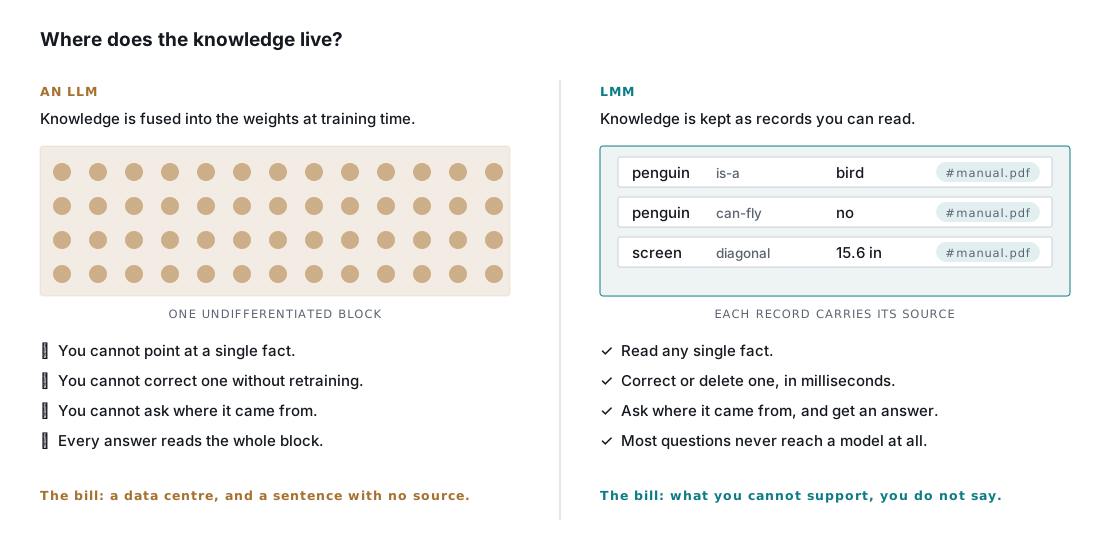
LMM keeps the knowledge outside the model, as records you can read:
subject      predicate    value      source          trust   time
penguin      is-a         bird       #manual.pdf     0.60    2026-09-05
penguin      can-fly      no         #manual.pdf     0.60    2026-09-05
- You can point at a single fact, correct it, delete it — in milliseconds, with no retraining.
- Every record carries its source and a trust level; a derived fact sits below the speaking threshold on purpose — the system may reason with it, and may not assert it on its own.
- Most of the machinery — storing, deriving, counting, verifying — is plain Python over a dict. No GPU, no network, no key.
The engine stays small and does its one job: phrasing. It never decides what may be said; the gate does. A weaker engine costs you fluency, never provenance.
What that buys, concretely
Measured
Across every benchmark run published by this project — two languages, four corpora, three repeats each — the count of wrong facts asserted is zero. Not low: zero. The gate is structural, not a prompt.
- "I don't know" you can trust. Refusal is structural: when the memory holds nothing on a question, there is nothing the answer path can say. Measured across every benchmark run: zero wrong facts asserted.
- Answers with receipts. Every claim traces to a document, and in multi-document stores the answer names which document.
- Reading is nearly free. A document is read once, verbatim, with no summarisation at write time — so nothing is lost before anyone asks. The competitor's indexer spends hundreds of model calls summarising; a summary abstracts the specific value away, and the specific value is usually the answer.